
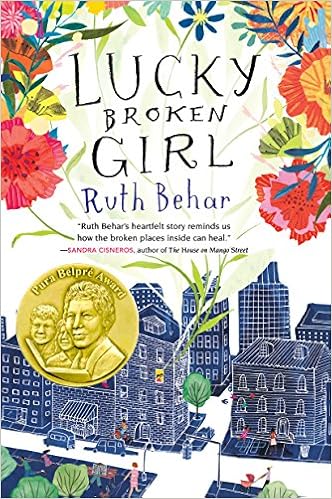
Behar, Ruth. (2017). Lucky broken girl. New York: Puffin Books.
Ruth's family has recently immigrated from Castro's Cuba to Queens, New York. Ruthie is learning English and fighting to get in the "smart class" at her school. In the neighborhood, she is the best at hopscotch and has friends in Ramu from India and Danielle from Belgium. But after a trip to see friends in Staten Island, Ruthie and her family are in a car accident and her injuries place her in a body cast. She is bedridden for almost a year due to the cast. She struggles with being helpless, afraid, and alone. The doctor tells her to pray. So she prays to God to help her. After Ramu returns to India following the tragic death of his little brother, she adds Shiva to her prayers. After meeting Chicho from Mexico, she learns of Freida Kahlo who also spent a large portion of her life in a body cast. She too becomes part of the prayers. As she heals, Ruthie learns that she can conquer fear and perhaps she can be more than the secretary her father would like her to be, even a writer and artist.
This story is semi-autobiographical, which I found quite interesting. Ruth Behar did spend a year in a body cast, but she has adjusted her story to make it more interesting to readers. Part of what I found fascinating was the story of Ruthie's grandparents. I knew of the tie between Cuba and Russia but had never considered that people had immigrated from Russia and Poland to Cuba. I also considered Cuba to be a predominately Catholic country pre-Castro, so this idea that there were Jewish immigrants to Cuba was new to me.
I loved Ruthie's relationship with her teacher Joy and her neighbor Chicho developed. Both characters challenge Ruthie to think beyond the walls of her bedroom. Chicho helps her see that she can walk again without fear and that life is to be celebrated. I found myself wishing for someone like him in my life.
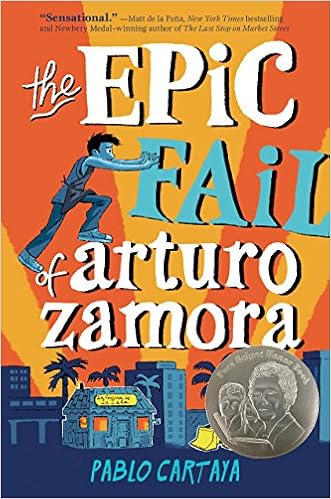
Cartaya, Pablo. (2017). The epic fail of Arturo Zamora. New York: Puffin Books.
Arturo's family runs a local restaurant in Canal Grove, a neighborhood in Miami. His abuela started the business after she and her husband fled Cuba. Now Abuela is retired and his mother is the acclaimed chef, and the entire family works there including Arturo. The lot next door is available and the family would like to expand the restaurant. A businessman also wants the lot, along with the lot La Cucina de la Isla is on. Arturo and his family have to fight to save the family business. Along with the fight to save the restaurant, Arturo finds himself having feeling for his god sister who is visiting from Spain. Together they try to find a way to stop Pipo from getting their lot. Abuela, who is ill, gives Arturo a box of letters from his grandfather who died many years earlier. Through these letters, he learns that his abuelo loved poetry and felt that love was a great gift and risk. Arturo learns to stand up to Pipo and share how important family and community is with the city council, his neighbors, and his family.
This was quick read. I didn't want to stop because I was dying to know what the epic fail was. Part of me knew that they would save the restaurant (it had to happen), but it was the letters and Arturo's relationship with his grandmother that I really enjoyed. His grandmother was this amazing spirit that loved her family and life. The idea that his grandfather knew he wouldn't see Arturo grow up and wrote these letters was touching. He shared his experience with love and poetry with a 13 year old boy who needed to hear it. "Lo mas importante es el amor y la fe". This family has both!


 Roth, V.(2018). The fates divide. New York: Katherine Tegan Books.
