Saturday, November 26, 2016

George

Image result for george alex ginoGino, A. (2015). George. New York: Scholastic.

George has the body of boy but knows that she is a girl. In her bathroom, with the door locked, she looks at girls in magazines and wishes she looked like them. George also wants to be Charlotte in the fourth grade production of Charlotte's Web. Although her audition is perfect, George's teacher will not give her the part because George isn't a girl. With the help of her best friend, Kelly, George gets the courage to tell his mother and brother that she is girl. Kelly also gives her the most incredible experience. She takes George to the Bronx Zoo as her girl self, Melissa. For the first time ever, Melissa is truly happy.

This is such a timely book, especially with recent political issues regarding the LGBT community. How wonderful it is to finally have a character that a transgender child can relate to. I can imagine that this book is also being contested by conservative parents and groups. Every child should be able to find him/herself in a book, the LGBT community included! I was thrilled to see this in my school library! I'm not sure how to teach it without upsetting parents, but I think a copy may find its way onto my classroom shelf.

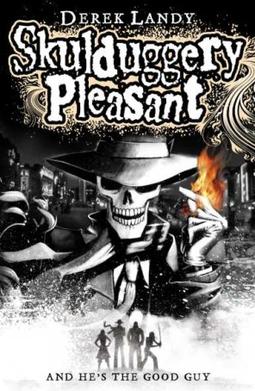
Skulduggery Pleasant

Skulduggery Pleasant book cover.jpgLandry, D. (2007). Skulduggery Pleasant. New York: Harper Collins.

Years ago Skulduggery Pleasant was a mage involved in a war. When he died, he brought himself back to life and swore to protect everyone from Serpine. Stephanie's uncle has just died and left her everything, including something that people are willing to kill for. Skulduggery steps in to save her and they end up working together to find who murdered her uncle and where the Scepter of the Ancients may be hidden. But as they search, they learn that Serpine is behind everything and wants the Sceptre so that he can attack the Sanctuary and use the Book of Names to rule the world. Skulduggery and Stephanie must battle him to protect the world.

This is the first book in a series and was very hard to find. The name was changed to The
Sceptre of the Ancients several years ago when it was released in paperback. I am a fantasy person and this book was great for me. It had all the magical elements that I love, as well as adventure. I see this as good stepping stone for my students who had gone through all the Rick Riordan books and need something new. I have several copies on order from Amazon!

Frogs

Image result for frogs nic bishopBishop, N. (2008). Frogs. New York: Scholastic.
Frogs! Everything you have ever wanted to know about frogs: what they eat, their organs, bones, skin, sizes, where they live, how they climb, and how they see. But what truly makes this book are the beautiful photographs. Mr. Bishop has photographed these animals up close and the pictures are amazing.

This is a very popular book in my class. It's readability level is low so it's accessible my most students. But what they love are the pictures! They will pour over the pages, just looking at the photographs. Then they read to see what the picture shows. They do the same with Spiders and Snakes, also by Nic Bishop.

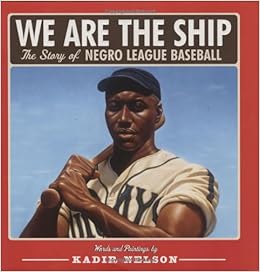
We Are The Ship

Image result for We are the ShipNelson, K. (2008). We are the Ship. New York: Hyperion.
This book tells the story(in nine innings or chapters) of the Negro Baseball League. Told in first person by an anonymous Negro League player, we learn of the history and the struggles of the Negro Baseball League. Many of these men played several games a day, in poor conditions. Due to segregation, they often slept in the bus or car they were travelling in. Restaurants refused them service. But the games were action packed and they drew crowds. Famous players stories are shared and we learn about how baseball became integrated. With Jackie Robinson's move to the majors, the Negro Baseball League slowly dissolved.

I like that this is literary nonfiction. It made a topic that may not be interesting to all, much more approachable.  I enjoy baseball, but it is not something that I'd chose to read about. The narrator made this much easier to read.

As for my students, I have several die hard baseball fans who would enjoy this. I usually share books about Jackie Robinson in coordination with a writing contest based on his life. I may bring this book in also to add more information and be another resource.

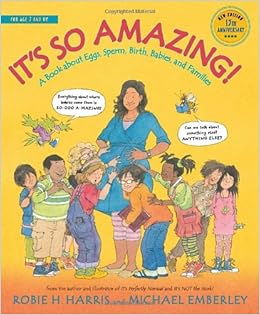
It's So Amazing

Image result for it's so amazingHarris, R. (1999). It's So Amazing. Boston: Candlewick. 
It's So Amazing is an honest and factual way to teach children about sex and reproduction. Narrated by a bird and a bee, it covers body parts, correct terminology, sex, love, how babies grow in utero, and birth. It uses cartoon-like illustrations to make the book more appealing to children, but in no way is condescending. It presents the facts in a way that a child can understand. 

This book has been contested due to its content. I was surprised to find it in the adult nonfiction area of my public library, rather than in the children's section. I knew there had been controversy about the content, but had no idea it was moved away from the children's section. Perhaps I'm a more open parent than some, but I see no issue with this book. I would share it with my child, so that I could answer any questions. But the material presented is correct and well written. I see no reason to "hide" it from children. 

Hate That Cat

Image result for hate that catCreech, S. (2010) Hate That Cat. New York: Harper Collins.
Jack is back for another year with Miss Stretchberry and poetry. Jack is now learning about how poets use sound in their poetry in the form of alliteration, assonance, and onomatopoeia. But Jack keeps wondering how people can experience sound in poetry by just reading it. His concern stems from his own mother. He wants to share his poems with her but she is deaf. How can she experience what he does without hearing it? Jack is also learning to love a new pet, a kitten. He's not sure about cats, especially after a bad experience with a stray black cat. But when his kitten goes missing and is saved by the black cat, Jack learns that maybe things are more than they seem.

I am currently teaching this book, along with Love that Dog, and Inside Out & Back Again. My students are enjoying the continuation of Jack's story. What they don't recognize are the techniques or the quality of poetry that Miss Stretchberry uses to teach.  And as we talk about the book, they slowly learn to appreciate it, as do my kids reading Love that Dog. Jack is a relatable character, especially for my boys. But as Jack learned to write and appreciate poetry, so did they.

Martina the Beautiful Cockroach

Image result for martina the beautiful cockroachDeedy, C. (2007). Martina the beautiful cockroach. Atlanta: Peachtree.

Martina is finally 21 days old, and as the most beautiful cockroach in Havana, it is time for her to select a husband. Her Cuban grandmother tells her of the coffee test; she is to spill a little coffee on each suitor's shoes to see how he reacts. First the rooster, then the pig, and the lizard all yell at her when she spills. It is finally when she meets Perez, the mouse, and he spills coffee on her shoes that she realizes that she has found the one for her. 

I love that the main character of this book is a cockroach, and a beautiful one at that. Denying social conventions of beautiful is wonderful for little girls to be exposed to. I also appreciate that this is a Cuban folk tale. When we teach folktales, we tend to use European, Chinese, and African stories. I think we need to broaden our scope and include stories from as many places as we can. I used this book in my class when it was a Bluebonnet book several years ago. My students enjoyed it but, like when you read Skippyjon Jones, you end up reading it with an accent unintentionally. No matter how I try, I cannot read it without a horribly fake Spanish accent. It just creeps up on you as you read! I worry that someday I will offend someone! 

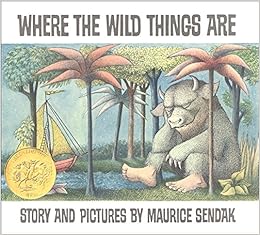
Where the Wild Things Are

Image result for Where the wild things areSendak, M. (1963). Where the Wild Things Are. New York: Harper Collins.

Max, while wearing his wolf suit, creates enough mischief that his mother sends him to bed without supper. While in his room, it transforms into a forest and an ocean. Max sails across the ocean to where the wild things are. He becomes their king and they have a wild rumpus, but Max is lonely. He wants to be loved best of all. So he sails back and goes through the forest to his room, where he finds is dinner, hot.

This book is an essential part of every childhood. My mom read it to me as a child, and I have read it to my own children and to my classes. This idea that a child can be a wild thing and still be loved unconditionally by his/her mother is timeless. Children need to know that parents will always love them, no matter what they do or say. It is my go to book when I have a baby shower or birthday party to purchase a gift for. It's just one of those books every child should have.

This is Not My Hat

Image result for this is not my hatKlassen, J. (2012).This is not My Hat. Boston: Candlewick.
The little fish has stolen a hat from a big fish and is going to hide in the tall plants. As he tells his plans, the illustrations show that the big fish has woken up, realized that his hat is gone, and is looking for the little fish. The story ends with the big fish leaving the tall plants with his hat on his head. We do not know what happened to the little fish, but we can guess!

It is the illustrations that make this such a fun book. As the little fish talks, the pictures show what is really happening and that is the humor in this book. This is a great book for inferencing. Students can use the illustrations to tell what the big fish is thinking and what he is going to do. They can also infer about what happens in the tall plants when we can't see. What would the big fish do to the little fish?

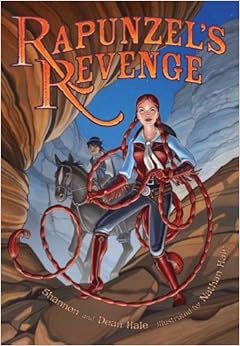
Rapunzel's Revenge

Image result for rapunzel's revengeHale, S. and Hale, D. (2008). Rapunzel's Revenge. New York: Bloomsbury.
We all know the traditional story of Rapunzel: Mom craved lettuce. Dad stole it from the witch's garden. Witch got mad and took the baby. She raised her in a tower and she was rescued by a prince. Not quite... In this version, set in the wild west, Rapunzel escapes her tower, becomes involved with a thief named Jack, and uses her long braids as weapons. She is determined to punish Mother Gothel for all that she has done to Rapunzel and the people she meets on her journey. By destroying the source of Mother Gothel's magic, Rapunzel wins.

This is not what I am used to from Shannon Hale. In fact I had no idea that she did graphic novels. I can't say that I like this as much as I do her other works. She has always put her own twist on fairy tales, but this was hard for me to get into. I can see the appeal to children, as Rapunzel is much more than a maiden in distress. I appreciate a strong female character who can take care of herself. Perhaps it was the old west setting that bothered me. I've never been one for westerns. Either way, this story has appeal for children, just not for me. Perhaps during lessons on traditional literature, this book would be a fun comparison to the original tale.

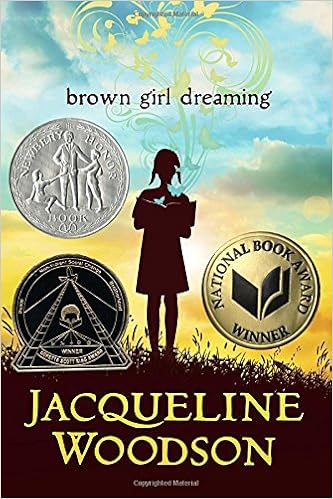
Brown Girl Dreaming

Image result for Brown girl dreamingWoodson, J. (2014). Brown Girl Dreaming. New York: Penguin.
This series of autobiographical poems tells of Jacqueline's childhood in Ohio, South Carolina, and New York in the 1960s and 1970s. She shares her experiences with the Civil Rights Movement, life in her grandparents' home, and growing up as a Jehovah's Witness. She also tells of her family, it's history and their story as well. Despite her struggles in school, she finds that she has a gift for words and begins to write poetry to express herself.

I read this book when it first came out and loved the beauty of the words. I could see the house in South Carolina, I knew what Gunnar looked liked and could hear his voice. Once she was in New York, I loved it more for that is where I grew up. I knew the city and I even knew Dannemora prison where her uncle was incarcerated, since I went to college right near it. Jacqueline and I are just a few years apart in age so there was that connection as well. She described things I remembered from my childhood. I did not experience everything that she did, but there was enough that I developed a connection with this book. It is one of my current favorites.

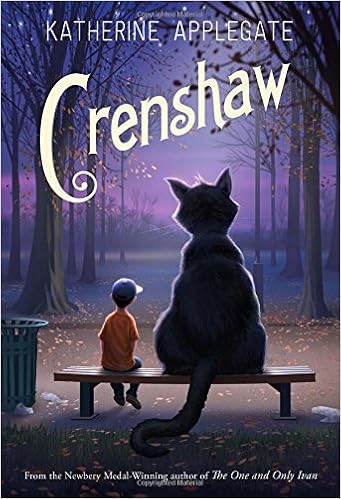
Crenshaw

Image result for crenshaw bookApplegate, K. (2015) Crenshaw. New York: Feiwel and Friends.

Jackson's family is in trouble. His dad has MS and cannot work. His mother has lost her job as a part time music teacher and is now waiting tables to make money. They can't pay the rent and are being evicted. And suddenly Jackson's imaginary friend, a giant cat named Crenshaw is back! As Jackson faces homelessness again (as we learn through a flashback), Crenshaw is there to help him through it and to find his voice to confront his parents about his feelings.

This book had been making the rounds in my classroom. I gave a copy to a student as a gift, and she has shared it with most of my class. Half of my class lives in a very nice subdivision. The other half lives in government subsidized housing. It was interesting to see reactions and hear them talk about the book. Several focused on Crenshaw and how great it would be to have an imaginary friend or talked about their imaginary friends. Others talked about how they understood how Jackson feels. How they get food from Helping Hands or waiting for mom to get a job so that they could get shoes at Goodwill is what connected them to the book. I think it opened the eyes of my more fortunate students; that not everyone has what they have and life can change in a blink.

Close to Famous

Image result for close to famousBauer, J. (2011) Close to Famous. New York: Puffin.
Foster and her mom are on the run from her mother's abusive boyfriend. They end up Culpepper, West Virginia, a small town with some interesting characters including a boy who wants to make films but doesn't have a camera, a woman determined to help others despite having very little herself, and a movie star hiding from her life. Foster has a gift and a problem. She is a very talented baker, as the town soon discovers,  but she cannot read or write. Her struggles with reading come to light when she fills in  for Macon at his job at Miss Charleena's house. Miss Charleena also struggled with reading and is willing to teach Foster. As the story progresses, Foster and her friends learn that they must face what they are afraid of, be it ex-boyfriends, escaped convicts, or the press in order to move on in their lives.

This story reminds me of Fish in a Tree. Foster has so much in common with Ally. They both have talents but cannot read. Foster can bake, while Ally is an artist. It takes someone special to notice that they have an issue with reading and to help them. Both girls have military fathers; Foster has lost her father in the war, while Ally's is still deployed. And both girls struggle with hiding their reading issues from those around them. I used Fish in a Tree last year as a read aloud. I may put this book in the hands of a couple of my girls who loved Fish, and see what they think.


Dear Mr. Henshaw

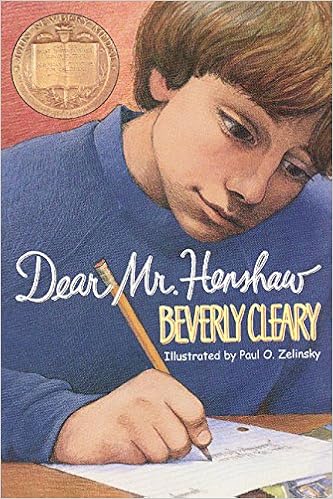
Image result for Dear Mr. henshaw Cleary, B. (1983).  Dear Mr. Henshaw. New York. Scholastic.

Leigh has been assigned to write to an author. He chooses Mr. Henshaw, the author of his favorite book Ways to Amuse a Dog. In the letter he asks a lot of questions. Mr. Henshaw replies with a list of questions of his own. What results is an unusual pen pal relationship between Leigh and Mr. Henshaw. We learn about Leigh's relationship with his father, his parents' divorce, and his struggles at school. By writing to Mr. Henshaw in letters and in journal form, Leigh comes to understand that he can be a writer and that he is stronger than he thinks.

I'll be honest; I've never been a fan of this book. I know it won the Newberry and it is by one of the best children's authors ever, but I have just never gotten into it. I know teachers who love to teach this book, but even though it is on the fourth grade list, I don't teach it. Perhaps by allowing my own opinion of the book to cloud my judgement, I'm not getting this book in the hands of children who might connect with it. How does that work as a librarian? We can't be expected to love every book, so how do we keep that open mind and promote something that we don't care for? Are we honest that we didn't like the book, but they might? Do we keep our opinions to ourselves? Hmmmm... something for me to ponder.

How they Croaked

Image result for how they croakedBragg, G. (2011). How they Croaked: The awful ends of the awfully famous. New York: Walker.
How They Croaked tells how 19 famous people really died. From King Tut to Albert Einstein, we learn exactly how it happened. Each chapter covers a different person's death and ends with two pages of interesting facts about parts of their lives or medical procedures used by the doctors of that time.

I see this book as one that would be very popular in my classroom. There is something about gross and macabre that draws kids to a book. Plus death is such a mystery that it would hold great appeal. I think I would use this book as a reference as we learned about famous people. The information presented gives a look at their lives that many of us do not know. I had no idea about Charles Dickens being manic depressive or that Darwin had such phobias. I do have the companion book, How They Choked, in my class library. I think I need to pull it out!

Knuffle Bunny

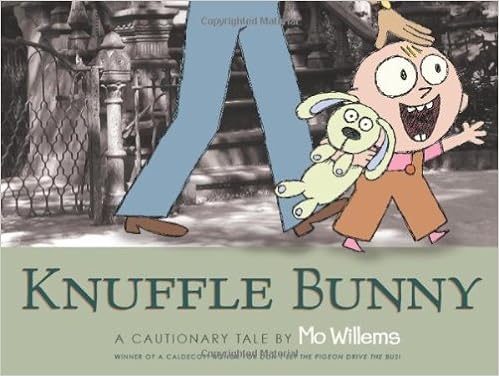
Image result for Knuffle BunnyWillems, M. (2004). Knuffle Bunny. New York: Balzer + Bray.

Trixie and her daddy are off to the laundromat! Trixie is super excited that she and her Knuffle Bunny get to help daddy with the laundry. But on the way home, Trixie realizes that Knuffle Bunny is missing! And even though she tries everything to tell her daddy that Knuffle Bunny is gone, including going boneless, he just doesn't understand. But as soon as they get home, her mommy asks where Knuffle Bunny is. The whole family dashes back to the laundromat to find Knuffle Bunny in the wash. And Trixie speaks her first real words!


Knuffle Bunny has a very special place in my heart. It was published the same year as my son was born and was given as a shower gift. My daughter was three. She had a bunny that she adored, called bedtime bunny. He went everywhere with us. She also had an articulation problem, which meant most people could not understand her when she spoke. Reading this book to her the first time was incredible. Katrina made the connection that she was like Trixie and that kids in books could be like her! Her father and I loved this book also, for we had dealt with the child going boneless in frustration because we didn't understand what she wanted. I even have a copy put aside for when Katrina had her first baby!

The Three Pigs

Image result for The Three pigs WiesnerWeisner, D. (2001). The Three Pigs. New York: Clarion.
It starts like the Three Pigs we all know. But when the wolf huffs and puffs, he blows the first pig right off the page of the book! The pig then rescues his brothers and they explore the world outside of their book. The visit Hey Diddle and meet the cat and his fiddle. They also rescue a dragon who was about to be killed. Together they return to the 3rd pigs house in the pigs' story and defeat the wolf and live happily ever after.

I love the twist in the middle of this book. That the pigs could escape their story and villain, and see what else was going on is very original. I can see using this book as a way to compare text. As a current 4th grade teacher, that is a skill that  my students must have. I will include this in my plans for the 3rd nine weeks when we do paired passages.  I think my students will enjoy the humor and the plot twist.

Happy Birthday Babymouse

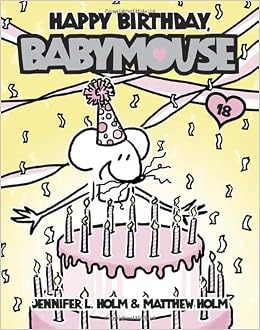
Image result for Happy Birthday babymouseHolm, J and Holm, M. (2014). Happy Birthday Babymouse. New York: Random House.
Babymouse's birthdays have been a disaster, but this year's is going to be the best yet! Until she learns that Felicia's party is the same day and everyone is going to Felicia's! And then it all starts falling apart. Nothing goes the way she planned. On Monday at school, as everyone raves about Felicia's party, Babymouse sulks by herself. But her friends come over and celebrate with her. Now she can laugh about all that went wrong!

My students love Babymouse, but I had never read one until now. I enjoyed how the author talks to her and that aside interaction. I also liked how they included characters from other books. The colors are simple so the book isn't visually confusing. Overall,this is a book series I will invest in for my students.

Balloons Over Broadway

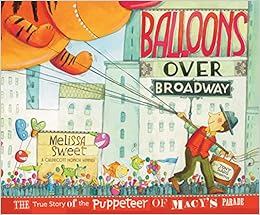
Image result for Balloons over Broadway Sweet, M. (2001). Balloons Over Broadway: The true story of the the puppeteer of Macy's Parade. Boston: Houghton Mifflin.
Tony Sarg was a puppeteer. He created beautiful marionettes and put on wonderful shows. His fame spread and he was hired by Macy's to create a holiday window display. He created mechanical marionettes for the window and it was a huge success. Macy's later hired Tony to create some kind of puppet for their annual Thanksgiving Day parade. What Tony developed are the balloons that we love to watch today. The rope handlers below could make his balloons move, just as a puppeteer could move its puppet. Those balloons are now an integral part of the Macy's parade.

As I write this, it is just two day's past Thanksgiving. I grew up in a suburb of New York City and the parade was always a part of our Thanksgiving. You could go into the city and see them being inflated the night before. Or you could watch it on the news. We never watched the parade in person. It was too hard to get into the city and find parking on such a crazy day. I stayed in my pajamas in front of the TV and waited for my favorite balloons to come by. Underdog and Felix the Cat were mine!  I still watch the parade in my pajamas every year. Now that I have read this book, I have a much greater appreciation for those balloon I loved as a child.

Mirror Mirror

Related imageSinger, M. (2010). Mirror Mirror. New York: Dutton.

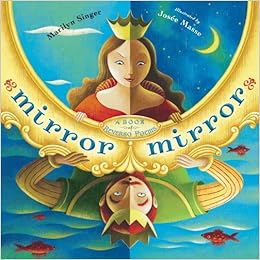
Mirror Mirror is a book of reverso poems, which are poems that can be read down and up. The careful selection of words allows the poem to have two different meanings, depending on how they are read. All of the poems in this book are based on fairy tales. So in reading down one poem, we learn about the witch fattening up Hansel. But as we read up, we see how Gretel is trying to keep him alive. The poems cover Snow White, Red Riding Hood, the Frog Prince, Rapunzel, and Beauty and the Beast.

The skill that goes into writing poetry like this is amazing. I cannot imagine the time it takes to make sure that each word works forwards and backwards. I have shared this book with my students before during poetry units. They loved reading them and several have tried to emulate them. But they too, struggled with making it work.

The Crossover

Image result for the crossoverAlexander, K. (2014). The Crossover. Boston: Houghton Mifflin.

Josh and his twin Jordan are the stars of their junior high basketball team. Their dad played professionally in the European league and would have been a pro in America, if he hadn't had an injury. And Josh seems to be following in his father's footsteps, until a series of events changes his life. His brother falls for a girl and basketball is no longer his priority. His father's health is an isssue, an issue that his father ignores, until he ends up in the hospital with a massive heart attack. Josh struggles to deal with losing his twin to other interest and losing his father to his bad health choices, all the while trying to be the best basketball player and win the county championship.

This book is written in free verse poetry and may be the perfect way to get some of my boys to read poetry. In some ways, Mr. Alexander's poems border on hip hop lyrics which would be very appealing to my students.

I enjoyed the character development. Seeing Josh deal with his brother's girl friend and the relationship between Josh and his dad drew me into the book. I wasn't sure I'd like this, as I am not a sports girl, but this was more about life than ball. I may even use it as a read aloud.

The Nest

Image result for the nest book Oppel, K. (2015). The Nest. New York: Simon & Schuster.
Steve's life has changed. His parents have had a new baby and it is sick. In his dreams, Steve is told by strange creatures that the baby can be fixed, if he says yes. These creatures are a kind of wasp, and using DNA taken when the queen stung Steve, they are making a whole new healthy baby in the nest in the eaves of the house. All Steve has to do is let them in the window to take the sick baby away. But what happens to the sick baby? Steve decides to keep the real baby, and despite his severe bee allergy, fight to save Theo's life.

This was a very unusual book. This idea of replacing a sick baby with a healthy one made me think of my friends who had dealt with sick children. Would they have traded the sick and dying child for a healthy one?
This seems a very "heavy" book for elementary children. I have a couple of students who I might suggest it to, but they are much stronger readers.

El Deafo

Image result for El Deafo

Bell, C. (2014). El Deafo. New York: Amulet

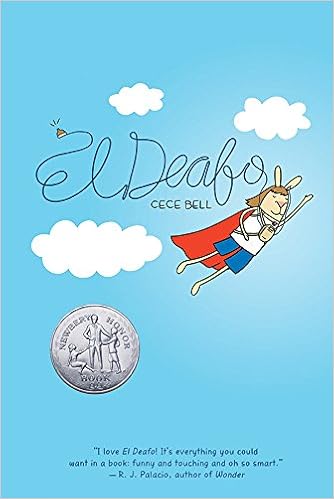
CeCe was a normal little girl until she got meningitis. The fever left her partially deaf. And so begins CeCe's life with hearing aides, lip reading, and struggles with school and friends. To cope with her struggles she imagines herself as a super hero, El Deafo, who can say all the things she wished she could say to her friends and teachers. She wants to make friends but wants to be treated like everyone else. The graphic novel format makes this book a fun and that fact that it is semi-autobiographical makes it even more interesting.

This is a very popular book in my classroom due to its graphic novel format. For me it was much more. This book is going to be a Christmas present for my daughter's godmother. Judy was born with nerve damage that caused her to lose most of her hearing. She too has dealt with hearing aides, lip reading classes, and where she fit in the hearing and deaf world. She has always said that no one quite understands what she went through as a child. Finally here is some one who did!

Monday, October 24, 2016

Good Masters! Sweet Ladies!

Image result for good masters sweet ladies

Schlitz, L.A. (2007). Good Masters! Sweet Ladies. Somerville: Candlewick Press.

Good Masters! Sweet Ladies! gives us a glimpse into life in Medieval times. Each character tells his or her story of their life in poetry or prose. These characters are all children, from all levels of medieval society. They share the good and bad about their lives. For many, their lives are harsh. Even those in privilege are not always happy. The author also includes sections of non-fiction to help the reader further understand what each character is talking about. Topics include pilgrimages, the Crusades, falconry, and Judiasm.

This would be a wonderful book to use with Catherine, Called Birdy. The explanations it offers would support the reader as they go through Catherine.

I enjoyed this book, as I am very interested in this time period. I appreciated that the author didn't sugar coat anything. She depicts life as it really was at the time, including death and prejudice.

Rules

Image result for rules cynthia lord

Lord, C. (2006). Rules. New York: Scholastic.

Catherine's life is full of rules. With a brother with autism, it has to be. David needs those rules to cope with the world and Catherine needs those rules to cope with David. She feels like David gets all the attention and her needs get pushed to the side. When a new neighbor moves in, Catherine thinks she has a chance to be a normal kid, but her own embarrassment at David keeps her from getting there. Plus there is Jason, the boy at the clinic with Cerebral Palsy. She's making him word cards and talking with him, but when Kristi asks about him, Catherine again is embarrassed. She has to learn not to worry about what she or others think and to speak up for herself.

This book struck a chord with me. You see, my nephew and my son are both autistic. For years, I have worried about them. Would they adjust to school? What would the other children think or say? How many teachers will I have to battle? But I have also worried about their big sisters, especially my niece Kathryn (ironic!). Her brother is very much like David. He echos TV shows that he loves and is constantly being reminded of the rules. Kathryn has spent so much of her life taking care of him, that I have worried about her needs. She, unlike Catherine, never found her voice. My niece ended up in the hospital after a suicide attempt. I wonder if she had seen this book if it would have made a difference in her life.